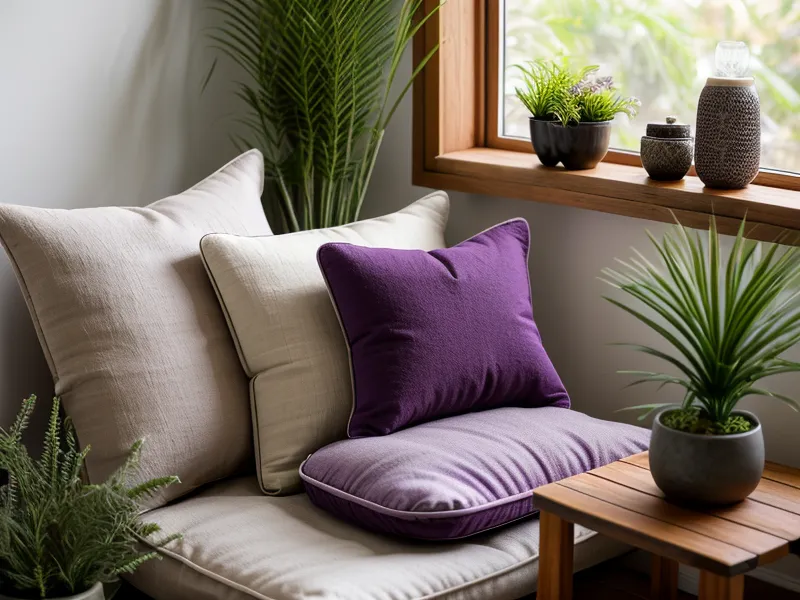
The Trouble With Sitting Still
My left foot has gone from pins-and-needles to fully numb, and I'm still sitting on it, negotiating with myself about whether standing up counts as giving up. Three minutes into what's supposed to be meditation, and my brain has already storyboarded a whole illustration, scrapped it, and started composing a reply to a message I haven't even opened yet. Nobody tells you that for some of us, stillness doesn't feel peaceful. It feels like holding a door shut against something that really wants out.
Two years into a spiritual awakening I never asked for — the kind that showed up uninvited during a freelance drought so brutal I nearly took a coffee-shop job just for the schedule — I assumed meditation would be the thing that steadied me. It hasn't worked that way, not in Portland, not for a freelance illustrator whose hands are used to always moving. Every beginner meditation guide I found promised stillness like it was a light switch you could just flip. Mindfulness for creatives, it turns out, is a slower and messier process than that, and it didn't come from any of the places I was told to look.
Here is the thing: my hands draw for a living. My mind spends all day layering color and shape and negative space, and asking it to go blank felt less like relaxation and more like asking a hummingbird to sit still on a branch. It wasn't laziness. It wasn't a lack of discipline. It was a nervous system that had no idea how to downshift, paired with a body that had spent years being professionally restless.
What Didn't Work
For a while I thought the fix was rigor. I found a strict Zen-style sitting schedule online — twenty minutes, twice a day, no skipped days — set a timer, and lowered myself onto a meditation cushion every single morning like I was clocking into a job I hadn't applied for. My knees hated it almost immediately, a dull ache that showed up around minute twelve and stuck around for the rest of the day. I kept going anyway, because quitting felt like proof I wasn't serious enough about any of this.
Two weeks of that convinced me the problem wasn't my knees, or even the cushion. It was the schedule itself — the assumption that enough discipline could out-argue a body that wasn't ready to be still yet. My neighbor Bex, who lives two floors up and has a gift for cutting straight through anything I'm overthinking, just shrugged when I told her about it. Maybe you're sitting wrong, she said, and went back to her coffee. She wasn't entirely right, but she wasn't wrong either.
One of the group sound baths I went through that year left the deepest mark, if only physically, I still remember the tail end of a singing bowl note stretching out inside a low-ceilinged room until it felt like it hadn't finished ringing even after everyone around me had already exhaled. It was genuinely beautiful. It also wore off by the time I got to my car.
That whole year had me down every rabbit hole available to a woman with Wi-Fi and a wounded nervous system. I tried binaural beat tracks that promised to shortcut me into some deeper brainwave state, downloaded a grounding-practice app that had me picturing roots growing out through the soles of my feet, tracked synchronicities in parking spots and receipt totals, and worked through a handful of shadow-work journaling prompts from a Facebook group before abandoning most of them by the second question. I wondered, more than once, whether what I was going through counted as a dark night of the soul or was just a rough year, and whether the static under my skin was some version of kundalini energy waking up sideways. Somewhere in there I also spent a stretch wondering if illustration was even my soul purpose or just the job that happened to pay rent. None of it explained why sitting still felt like a threat.
Stillness Isn't Necessarily the Goal
About six months into this, I finally looked up the term monkey mind. In Buddhist traditions it's kapicitta, the mind swinging branch to branch, never settling. Knowing this wasn't just a me problem helped. The standard advice to simply observe the monkey did not help much, because my particular monkey ran on espresso and looming deadlines.
What actually explained something was proprioception, the body's sense of its own position and movement. When I forced myself to sit perfectly still, my proprioception went into overdrive. Every itch registered like a fire alarm. Every small muscle twitch felt seismic. My nervous system wasn't being dramatic. It was doing exactly what a trapped animal does.
I need to admit something I don't say out loud much: I almost quit meditating altogether around this point. I felt like an alien next to friends who seemed to drift into calm without trying, and I've written elsewhere about navigating friendships after awakening and how isolating it gets when your inside doesn't match anyone else's outside. A creative contact I'd met through an online community for spiritually curious artists, Obi Nkosi, put language to it before I could. Obi thinks in frameworks the way I think in sketches, and one offhand line stuck with me: you can't meditate a body into stillness that hasn't finished being afraid.
Something Shifted Around Week Seven
Somewhere around the seventh week of just showing up without measuring any of it, I was walking to New Seasons for nothing in particular (milk, maybe, or just an excuse to leave the apartment) and I stopped dead on the sidewalk because a magnolia tree I must have passed two dozen times had fully bloomed and I had genuinely never noticed it before. Not glanced at it. Seen it, the way you see something for the first time even though it's been there for years.
No lightning bolt. No sense that the ground had shifted under me. Just a tree, and the fact that I was paying enough attention to catch it instead of already three blocks ahead inside my own head. That's the whole story, and it's a strange thing to call a breakthrough, but it was the first real evidence I had that any of this was doing something.
Practical Meditation for a Restless, Freelance Mind
The bigger shift happened a bit later, on a morning with a book-cover deadline breathing down my neck and a body vibrating with a kind of anxious static I couldn't sit through. Instead of forcing myself onto the cushion, I laced up my shoes and walked the steep loop up Mount Tabor Park (the side that gets your heart rate up fast) until my legs were shaking and my mind had run out of things left to draft.
When I got back and sat down on the living room floor, I didn't have to try to be still. I just was. My body was too tired to fidget and my mind was too worn out to storyboard anything. Ten minutes passed before I noticed ten minutes had passed, which had never once happened to me in an entire year of trying.
That's become the actual practice, more than any app or cushion, though I still use both sometimes. Discharge the energy first, then sit. Burpees, a fast lap of Mount Tabor Park, aggressive vacuuming, dancing badly to something loud: anything that spends the restlessness instead of fighting it. Once the body has somewhere to put its energy, the mind tends to follow it down.
If you're new to this and sitting still already feels like failing, try starting with movement instead of stillness. Before you even look at a cushion, do something that gets your heart rate up for five minutes, whatever you've got, however unglamorous. You're telling your nervous system it's safe to let go of whatever fight-or-flight charge it's holding, rather than asking it to drop everything cold. From there, skip the instruction to empty your mind entirely, because that's not actually possible for anyone. Pick one physical sensation instead (the weight of your hands on your knees works for me) and when a thought about an unfinished sketch or an unanswered message pulls you away, just notice it and come back to that same weight. Forget the twenty-minute goal, too. Three minutes is roughly the length of a pop song, and starting there is not cheating.
Some days my meditation is just drawing repetitive patterns and watching the ink hit the page without trying to make anything of it, a moving meditation, more or less, minus the part where I have to sit cross-legged on the floor. Other days it's five intentional breaths on the balcony before I open my laptop, smelling whatever's cooking two units over. None of it looks like a spiritual practice from the outside. It keeps me functional, though, which was always the actual goal.
What I'd Tell a Beginner Now
Most mornings the monkey mind is a quiet little marmoset. Other mornings it's a full troop of howling baboons, and both are fine: the goal was never to get rid of the monkeys, just to stop letting them drive. I'm still figuring out most of this in real time, and mindfulness for creatives, at least in my case, has turned out to mean something closer to redirection than control.
If you only take one thing from any of this: stillness isn't where a wired nervous system starts. It's what's left over once you've spent the energy that was in the way. Move first (walk it, dance it, scrub something, whatever your version of Mount Tabor Park is) and then see how the sitting feels. I wrote once about why I stopped chasing the spiritual high and started paying attention, and this is the practical version of that lesson: the quiet was never the point. Noticing you've drifted, and coming back (a thousand times if it takes a thousand times), that's the whole practice.