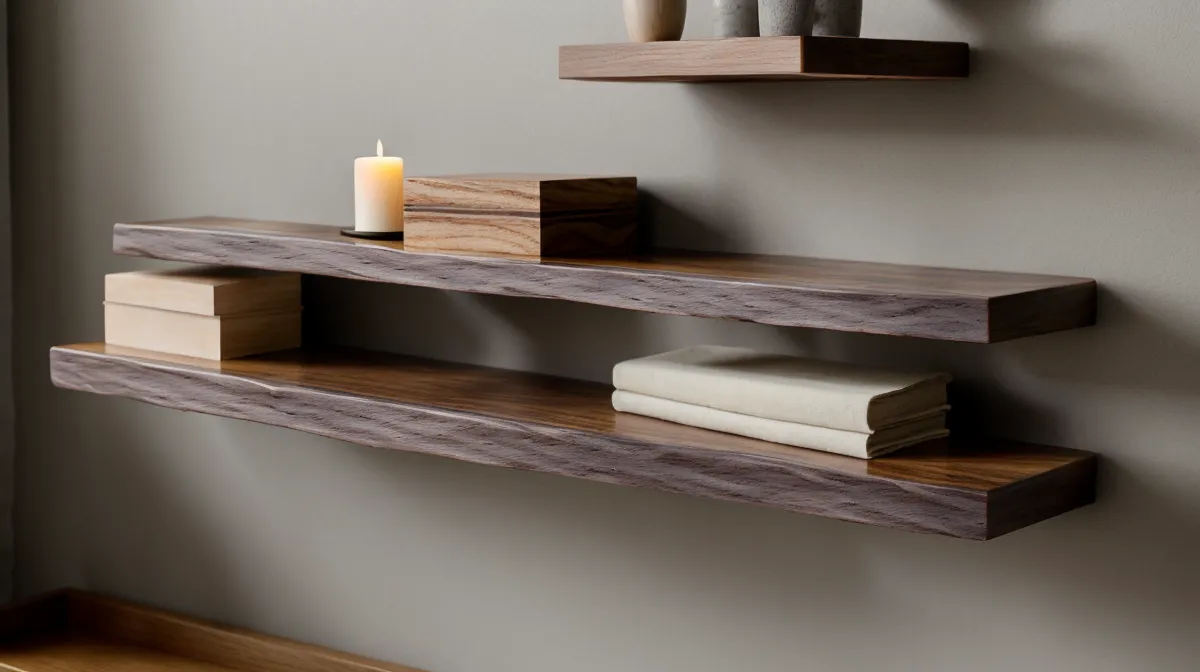
Dust collects fastest on the objects nobody touches anymore. That's what I finally noticed, really noticed, the day I stopped to actually look at the shelf crowding one wall of my small Portland studio. Minimalist spirituality gets pitched online like a Pinterest aesthetic (cream linen, one candle, a single smooth stone), but mine started as something a lot less photogenic: a shelf so packed with crystals, cards, and half-burned incense sticks that I'd stopped seeing any of it as sacred at all. It just read as clutter with better branding, the kind that comes from illustrating for a living inside 450 square feet, where every object either earns its space or it doesn't belong.
When the awakening first hit, back when everything about the world felt turned up a few notches too loud, I went straight into acquisition mode. If a YouTuber swore by a particular crystal for grounding, it was in my cart before the video ended. If a podcast suggested burning a certain herb to clear the air, I bought it, complicated ethics and all — that's its own subject I won't get into here. I was building a small forest of ritual objects while feeling more scattered by the week, not less.
The Year of Acquisition Mode
Every one of those objects felt necessary at the time. My altar shelf, not even two feet wide, ended up spreading onto the floor beside it because there was nowhere left to put anything. I had oracle decks stacked three deep that I hadn't touched in months, a couple of different dried herbs, and enough rose quartz scattered around that a stranger might've guessed I ran a rock shop out of my apartment. None of it was making me feel more grounded. It was just multiplying the number of things I had to dust and quietly feel guilty about.
Somewhere in that same stretch, I half expected one specific piece of quartz to kick off some dramatic kundalini energy shift the moment I held it during meditation, the kind of rush up the spine I'd read too much about online. It never did. It just sat there being a rock, same as the rest of them. I also leaned on brainwave entrainment around then, actual binaural beats through cheap earbuds, to push through a rough illustration deadline, and that one genuinely helped — proof that not everything from that acquisitive year was wasted, just most of it.
A Life Coach's Mirror Exercise Never Stuck
One thing that definitely didn't help: a life coach I worked with briefly had me stand in front of a mirror every morning and recite affirmations while holding eye contact with my own reflection. The theory, as it was explained to me, was that sustained eye contact with yourself builds a kind of self-trust. What it actually built was a deep discomfort with my own face first thing in the morning, and after about a week I quietly let the exercise go, more relieved than anything.
That's the pattern I kept running into that whole year: tools that sounded profound coming from someone else and felt hollow coming from me. Not every practice fits every nervous system, and the mirror exercise wasn't some failure of willpower on my part so much as a mismatch. I filed it away, kept looking, and eventually landed on the shelf itself as the actual problem, not some missing piece I still needed to find.
Reading the Shelf Through Negative Space
Sitting at my desk one afternoon, trying to finish a set of botanical illustrations, I kept glancing over at that overloaded shelf instead of my drawing. Twenty-five distinct items were competing for attention up there: crystals, feathers, coins, a small dish of old tea leaves, and the visual noise of all of it was drowning out whatever quiet signal I was actually trying to hear. It's hard to listen for anything internal when your eyes won't stop processing stuff.
I thought about Ma, the Japanese idea that the space between things carries as much meaning as the things themselves. I already understood that principle in my illustration work (negative space is what lets a subject breathe on the page), and it hadn't once occurred to me to apply it to a shelf of rocks. So I decided to strip it bare and find out whether the practice would hold up without the props doing the holding for me.
Curating Three Objects Instead of Twenty-Five
The audit took a while and turned out to be more emotional than I expected. Going through it item by item felt like a version of shadow work with the journaling stripped out: just me, a growing give-away pile, and the occasional flinch of recognizing exactly why I'd bought something. I picked up each item and asked myself, honestly, whether it helped me feel grounded or whether I just liked how it photographed. Most of them turned out to be just rocks — nice rocks, but not the actual source of anything I'd been through. I gave the bulk of the crystals to a friend just starting her own version of this, tucked the oracle decks into a drawer instead of the trash, and composted what had already dried into crumbles.
What was left, once I stopped, came down to three things. A stone I'd picked up on a walk through Ladd's Addition Rose Garden during a week that had been particularly hard, smooth, grey, and exactly palm-sized. One beeswax candle with no added scent and no glitter marketed as money-drawing, just the smell of honey and a steady flame. And a single blank page from my sketchbook, which changes daily — sometimes a word on it, sometimes a doodle, most days just white space I haven't filled in yet.
When I mentioned the empty-shelf experiment to Obi Nkosi, a creative contact I trade long emails with about exactly this kind of thing, they didn't let me get away with framing it as some abstract offering to the universe. They asked, reasonably, what I actually did with my hands during the week I tried it. Held a stone some mornings. Lit a candle on others. Left the page blank more often than not. That was the whole practice, once I said it out loud: nothing mystical about the mechanics of it, just fewer objects and more attention. This wasn't a dark night of the soul, either, just an hour of dusting and sore knees from crouching by a low shelf.
A Conscious Home in 450 Square Feet
There's something grounding about that kind of simplicity that I didn't expect going in. Grounding techniques for sensitive creatives tend to work better, I've found, when there's less competing for your senses in the first place: fewer decisions, fewer objects asking to be dusted, remembered, or felt guilty about. Holding that stone most mornings, rain ticking against the window somewhere behind me, doesn't ask anything of me the way the old shelf did. It's just weight and texture, nothing performing.
My neighbor Bex, who has exactly zero interest in any of this and has never once made me feel strange about it, noticed the bare shelf when she stopped by to borrow a charger. She just said something like "oh, you got rid of the rock pile" and moved straight on to a completely unrelated story, which might honestly be the most grounding response anyone's had to any of it. I didn't need a synchronicity, some repeating number on a receipt, to tell me the shelf had to change. Stubbing my toe on a cluster of amethyst at an ungodly hour one night did that job just fine.
Some weeks the shelf sits empty for days at a stretch, which took getting used to. If I'm following a moon reading creative schedule, I might set out a small bowl of salt for the length of a full moon and wash it away the next morning instead of letting it sit there indefinitely. Keeping the space temporary instead of permanent seems to be what keeps it from turning into exactly the kind of stagnant, dust-collecting corner that minimalist philosophy warns about: an altar that's always there stops being anything special and just becomes another surface.
Around six weeks after I cleared the shelf, I was back at my drafting table watching afternoon light shift slowly across a half-finished illustration, and it took a second to place what was actually missing from the moment: the usual low hum of guilt about client work I hadn't billed yet. It just wasn't there. Nothing dramatic happened to cause that shift, no lightning bolt or big insight, the noise had simply gotten quieter along with the shelf.
The Shelf Doesn't Need to Hold Everything
I still feel the old itch sometimes: a beautiful oracle deck in a shop window catches my eye and some part of me wants to add just one more thing to the toolkit. But then I remember the weight of that old shelf and how loud twenty-five objects were compared to three. Whether any of this maps onto some bigger soul purpose for my portfolio is a question for another afternoon; most days the only purpose in front of me is finishing whatever illustration is due next, and that's plenty.
If you're in a small space feeling crowded by your own spiritual stuff, here's the actual takeaway, not just a tidy ending: don't let an altar turn into one more deadline you're quietly failing. A bare shelf you actually use twice a week beats a crowded one you've stopped seeing completely. You don't need twenty-five objects to be paying attention. Most days, you don't even need three, just enough room to sit with yourself without tripping over your own tools in the dark.