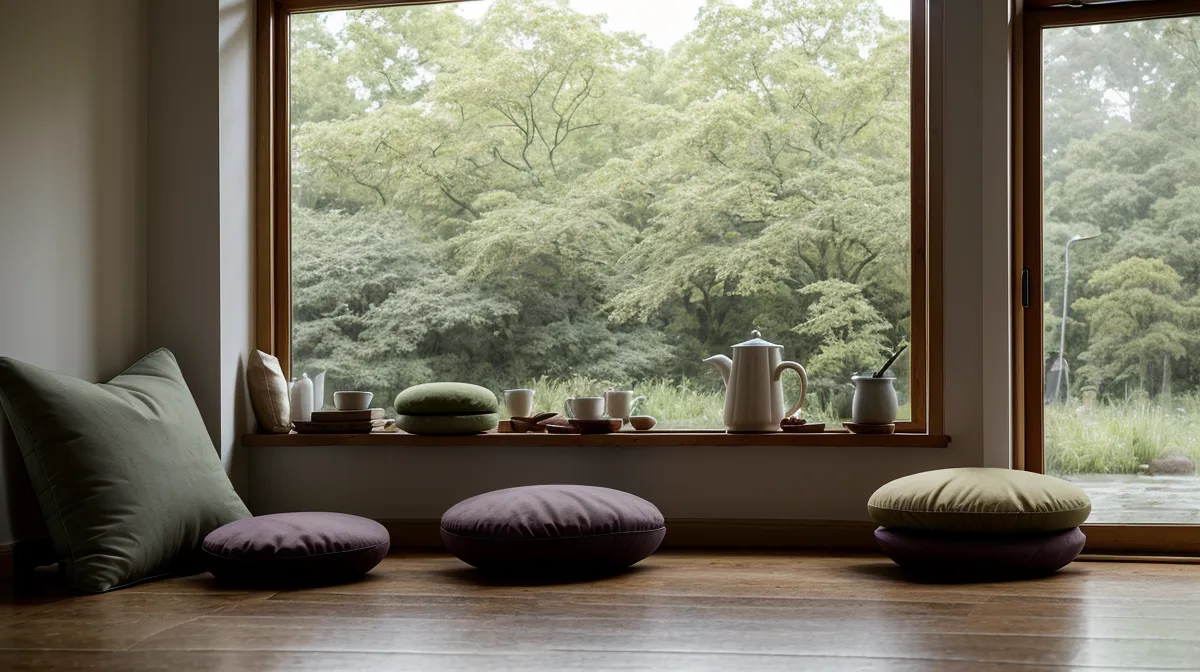
My daily practice doesn't stop my mornings from spiraling into worst-case thinking before my feet hit the floor. I still don't have a clean answer for what it means to have one, and I'm not sure I ever will, this deep into whatever spiritual awakening this turned out to be. What I've landed on instead is something smaller and far less photogenic: a routine most mornings that keeps the noise from swallowing my whole creative routine before I've even opened my laptop. It isn't mindfulness in the retreat-brochure sense. It's messier than that.
Mine started during a freelance drought bad enough that I stopped opening email before the coffee kicked in. My heart would do this fluttery thing that wasn't quite panic but wasn't calm either, just the ordinary too-muchness of being alive that apparently comes standard with a spiritual awakening. Somewhere in there my actual practice turned into another task I was failing at: unlit candles I felt guilty about, meditation apps sending streak notifications like tiny scolding texts, a bag of crystals gathering dust next to my pencils. It had become a performance, and staging it was exhausting.
My Spiritual Practice Started to Feel Like a Job
For a long time I thought handling this meant looking like the people in my feed: white linen, perfect light, the ability to sit still for an hour without wondering if I could afford more ink. The shift hit right in the middle of that freelance drought, and it was not pretty. It was messy. And somehow I still tried to polish it afterward, packaging chaos into something that looked serene for nobody in particular.
Spirituality can turn into another way to perform wellness fast — buy the objects, learn the vocabulary, act calm on cue. For an illustrator trying to keep her bank account out of the danger zone, that wasn't sustainable. It just added a new source of stress on top of the old one. I felt like a failure for not finding bliss while broke, which is its own particular flavor of miserable. That stretch lines up with what people call signs of a Dark Night of the Soul for creatives — the old way of working and the new way of "healing" both felt broken at the same time.
Turning the 35-Minute Reset Into a Daily Practice
I started experimenting with what I now think of as a 35-minute reset. It isn't a ritual and it isn't a ceremony — it's closer to a pressure valve, a way to let the volume turn down enough that I can actually work without feeling like the day is vibrating apart. I don't run it at dawn; I'm not that person. It usually happens mid-morning, once the coffee has landed and the first wave of emails is answered.
Some mornings it starts with clearing dried sage off the little altar I keep. There's a fine dust that clings to my fingertips long after I've moved on to answering emails — one of those small physical details nobody warns you about when they hand you a new habit.

Ten Minutes of Sitting With the Noise
Ten minutes on the timer, and I just sit. Clearing the mind is a myth that used to frustrate me endlessly, so I've stopped trying. I let the static play out instead. If I'm circling an overdue invoice, I name it out loud — "okay, we're thinking about money again" — and let it pass. If I'm still turning over a strange dream about an owl, same thing.
This is the everyday, unglamorous end of what gets called mindfulness — not a state to achieve, just the practice of noticing the noise without trying to stop it. Some mornings it's boring. Some mornings it's irritating. It's rarely profound. But it's honest, and honest turns out to matter more than profound most days.
Getting It Onto the Page
The middle fifteen minutes is the part that actually saves me. I grab a plain sketchbook — nothing gilt-edged — and write until the timer goes off. It isn't gratitude journaling and it isn't manifesting. It's closer to a brain dump, a way to get the pressure out of my chest and onto paper where I can actually look at it.
Some of it is synchronicities — three separate people mentioning the same obscure Polish poster artist inside one week, that sort of thing. More of it is mundane: my back hurts from hunching over a desk all day, the ghosted client still owes me an invoice, the rain hasn't let up in days. Writing it down turns the abstract buzz into concrete sentences I can actually close the notebook on. A fair amount of what surfaces here is shadow work, honestly — the unglamorous, un-Instagrammable half of a real practice, the part that never makes it onto anyone's altar aesthetic grid.
Moving Back Into the Day
The last ten minutes matter more than I expected, and it's the part I used to skip. I stop sitting and I move. Some mornings that means an actual walk — five minutes down to the roses at Ladd's Addition Rose Garden and back, just enough to feel my legs working under me. Other mornings it's smaller: washing a few dishes, sorting pens by color, running a hand over paper stock to feel the texture change between weights.
My neighbor Bex has a gift for this kind of mundane grounding. She once caught me spiraling about a client and just handed me her grocery list, asked if I'd walk to the corner store with her instead of talking it through. It worked better than any breathing technique I'd been forcing on myself that week.
Whatever it looks like, the goal is bridging the gap between the inside of my head and the actual room I have to work in that day. I spent the better part of a year trying to live entirely in what I'd call meditation land and nearly lost the business because I forgot how to be a person who meets deadlines. These ten minutes are the handoff: I've listened to the noise, I've emptied out onto the page, now I'm here, with these tasks, in this body. Strip away the vocabulary and it's really just a grounding practice wearing a timer.
What Didn't Work
Worth naming the stuff that felt like a waste of time, or worse. A life coach once had me stand at a mirror every morning and recite affirmations while holding my own eye contact — supposed to build self-trust, apparently. I lasted about a week. Watching my own face say sentences that didn't feel true yet made me feel more disconnected from myself, not less, and I dropped it before it did any damage I could point to.
Chasing whether is moon reading accurate ate up more hours than I want to admit. The useful part was never the accuracy debate itself — it was the reminder to pay attention to my own cycles instead of hunting for someone else's magic answer. Kundalini worked the same way for me: some days felt like real energy moving, other days were probably just caffeine, and most of the time I've stopped needing to know which is which.
There are still mornings I feel a little ridiculous, sitting there listening to my own breath and wondering if any of it is doing anything at all. That doubt hasn't gone away and I've stopped expecting it to. Showing up without certainty turned out to be most of the practice.
Why Good Enough Beats Perfect
The biggest shift wasn't finding a perfect practice. It was accepting that good enough actually is the goal. Some mornings my ten minutes of sitting is just me deciding whether to buy a new office chair. Some days the fifteen minutes of writing is a grocery list. That's fine. The point was never a state of permanent enlightenment — it was showing up with whatever I actually had that day.
By the fourth week of doing this most mornings, something small happened on an ordinary Tuesday: I woke up, thought about the client who'd ghosted me, and didn't spiral through every worst-case version of what happens next before my feet hit the floor. No fireworks. Just the absence of a spiral I'd have expected on any other Tuesday. That's the whole shift, really — not a bigger practice, a quieter reaction to the same life.
Since starting this routine, the volume doesn't run my mornings the way it used to. The static is still there — it's always there now — but I've got somewhere to put it, and it helps me clock common third eye opening symptoms for creatives without letting them derail an entire workday. A friend from an online community for spiritually curious artists, Obi Nkosi, once described building something like this as infrastructure instead of a high to chase — practical language for something that had felt completely shapeless. It stuck with me more than most of what I read that year, including the accounts of the initial spiritual awakening itself, which is a stranger story for another time.
Some days I've got binaural beats running low while I sketch; other days silence does more, and I don't overthink which camp of brainwave entrainment I'm supposedly in — I just notice what quiets the noise that particular morning. This was never about landing on some grand soul-purpose statement for my illustration career either. It's smaller than that: staying present enough to keep making the work. It's not flashy. Nobody's posting a filtered photo of it. But it holds. And if I miss a day, I don't punish myself for it — I just wait for the next morning and try again.