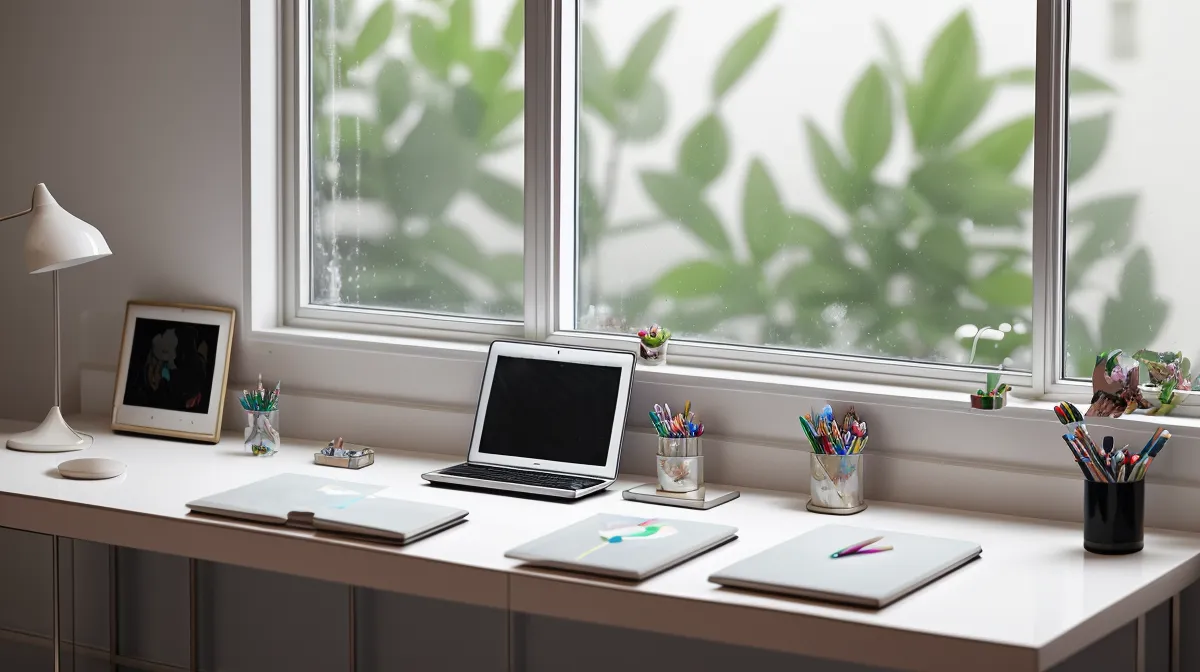
Four tabs are open on my laptop, each one a different guided breathing track, and I haven't pressed play on a single one. That's usually the clearest sign I'm in a creative block — not some dramatic collapse, just a dull, static kind of stuckness that makes my hand feel heavy before it even reaches the screen. I'm a freelance illustrator in Portland, and somewhere along the way I stopped treating that heaviness as a personal failing and started treating it as information: proof that whatever people mean by vibrational energy, mine had gone quiet.
Here is the thing almost every guide to this gets backwards: it treats vibration like a math problem, like there's a single correct number you're supposed to hit. Scroll through enough spiritual practice content and you'll find frequencies cited like gospel — a specific hertz for your jaw, a specific hertz for the earth, a precise slice of the light spectrum that's supposedly better for ideas. I used to believe most of it. I don't anymore, and whatever actually changed how I handle a block came from dropping the numbers, not finding the right one.
The Misconception About Vibrational Energy and Creative Block
The misconception goes like this: find the right input — the correct 440 Hz tuning note, the 528 Hz tone some people call the "transformation frequency," the right stretch of the 400-to-700-nanometer light spectrum — and your energy snaps into place, ideas included. Maybe some of that is real physics dressed up as mysticism. Maybe it's mysticism dressed up as physics. I genuinely can't tell you which, and at this point I don't think it matters, because the fix was never really about the number.
What actually changed things was noticing where my attention went when I felt stuck, then doing something physical to redirect it. No hertz required. Warmer light during a work session does feel different than the harsh, blue-white kind, and that's true without needing a specific nanometer attached to make it legitimate. I also started paying attention to how I use binaural beats to shift focus — less because I trust the exact science behind it, and more because the fifteen minutes of sitting still and actually listening does most of the work. It's closer to the kind of body-scan a decent therapist might walk you through than anything you'd find on a crystal shop shelf.

Where a Stuck Feeling Shows Up
Mine shows up in my throat first, almost always — a tightness that makes even typing a simple email feel like effort. Chest second. Hands last, which is almost funny for an illustrator, since the hands are usually the first thing to go still when the work genuinely isn't flowing. If your voice feels trapped when you try something like this, throat chakra healing for creatives is worth a look — I won't repeat all of it here, but the short version is that blocked expression and a tight throat tend to travel together.
Sometimes what reads as stagnation is actually something slower working itself out — a shift in what you even want to be making, which can look identical to a block from the outside. I've written elsewhere about heart chakra opening symptoms that mimic creative block almost exactly, and it's worth ruling that out before you assume you're just stuck.
Forced Positivity Isn't the Fix
Plenty of advice tells you to meditate the frustration away, to breathe until you feel grateful again. In my experience that usually backfires — it adds a second layer of irritation on top of the first one, now with the added shame of failing to feel better on command.
One afternoon I was far enough into a batch of character designs that I wanted to throw my tablet across the room. Instead of trying to meditate it away, I let the irritation draw something. Ugly, fast, not for any client — just the frustration moving through my hand instead of sitting in my jaw. That's closer to what people actually mean by shadow work than the gentler versions of it tend to get credit for.
What Actually Gets Me Unstuck
Sound still helps — the physical kind, not the metaphorical kind. Humming one low, sustained note until I feel it in my chest rather than my throat does something a scented candle never has, and it probably looks ridiculous from outside my apartment window. Whether that note needs to match a textbook pitch, I genuinely don't know, and I've stopped waiting to find out before I use it.
When my apartment starts to feel like the inside of my own skull, I leave. Most days that means walking over to Powell's Books on West Burnside and doing nothing useful there on purpose — no sketchbook, no notes app open, just drifting the aisles until my shoulders drop. It rarely produces an idea on the spot. It reliably produces enough quiet that an idea has somewhere to land later.
Some days the faster reset is plainer than a bookstore walk — a few minutes with my hands actually in dirt, no gloves, which edges into what people call a grounding practice without needing the full ritual version of it. Earth, skin, something that isn't a screen. That's most of it.

The clearest shift I've had recently didn't happen during any of this. It happened at three in the morning, pen moving across paper, three pages deep before I even remembered an overdue invoice that had been sitting in my inbox making me anxious for days. Nothing about that was scheduled or optimized. It happened because I was paying attention instead of performing a practice at it.
For what it's worth, not everything I've tried has stuck. I downloaded Headspace like everyone else I know and lasted about two months, lying there most mornings half-listening while mentally drafting an email to a client. Letting that subscription quietly lapse taught me more about what doesn't work for me than most of what succeeded did.
My friend Ingrid, who is skeptical of basically all of this and says so, asked me recently what journaling at three in the morning actually accomplishes. Fair question. I don't have a clean answer beyond: it got the invoice dread out of my chest and onto paper, and that was enough that particular morning.
The Actual Rule, If There Is One
None of this is about becoming a calmer, more enlightened version of myself — I still don't fully understand what happened to me a while back, the thing that started all of this, and that's a story for somewhere else, not here. What I do know is the rule underneath all of it: stop hunting for the one correct frequency, number, or app, and start noticing which specific, unglamorous action produces an actual felt shift in your body. Keep that one. Drop the rest, numbers and all.
If what you're calling a creative block feels heavier than any of this — if it's flattening whole weeks, not just an afternoon at the screen — that's worth bringing to an actual professional rather than a humming exercise. But if it's the ordinary, lead-handed kind of stuck, something physical and specific usually moves it faster than anything with a number attached to it.