The blank page and the dream are the same problem wearing different faces. One is empty because nothing has arrived yet, the other is full and the only trouble is I haven't learned to stay in it long enough to look around. That gap is what pulled me toward lucid dreaming, not as a trick for flying over cities, but as an unglamorous extension of my creative process, a form of consciousness exploration that happens to also produce color palettes. A third of my life happens with my eyes closed, and I wanted in on that time as a working illustrator, not just as someone doing an involuntary eight-hour shift.
Work had gone quiet by the time any of this started — the kind of quiet where you refresh your inbox out of habit more than hope. I'd already tried a Headspace subscription that year and abandoned it two months in, once the guided voice started feeling like background noise instead of help. Meditation apps weren't the doorway for me. Sleep was.
Lucid Dreaming as Part of My Creative Process
So I started looking into lucid dreaming, not for the novelty of flying over a city, but as a way to actually go to work. I'm not a sleep researcher and I'm not a doctor — just an illustrator who got tired of staring at a blank screen and figured there might be a shift happening somewhere I wasn't clocking in for. The technique I landed on is called MILD, short for Mnemonic Induction of Lucid Dreams, developed by Stephen LaBerge at Stanford. It's more practical than mystical, which is exactly what I needed.

The idea is to set an intention right as you're falling asleep — repeating a phrase while picturing yourself noticing you're dreaming. Mine was some version of 'next time this is a dream, I'll know it.' I started doing this on nights I had nothing left for revisions, treating sleep less like a black box and more like a shift I'd forgotten I was scheduled for. There's real science behind how dreaming changes shape across a night's sleep, but I'll leave the mechanics to people who study it for a living — what mattered to me was showing up for the part of the night that was already happening whether I paid attention or not.
It didn't work right away, and I want to be honest about that part instead of skipping to the good bit. For weeks, my "lucid" dreams were really just unusually vivid dreams about unpaid invoices — not exactly the muse showing up. By week eight, the dreams had started holding together longer instead of dissolving the moment I noticed I was inside one, though I still catch myself wondering whether I actually got better at this or just better at making meaning out of static afterward.
The clearest sign wasn't even a dream. It was an ordinary Tuesday — I got up, made coffee, and was three sips in before I noticed I hadn't run my usual worst-case list for the day. No rehearsal of everything that could go wrong before nine. Just up, and out the door.
Watching My Palm Turn Into a Map
Reality testing happens during the day, not at night — you ask yourself if you're dreaming while you're awake, usually by checking your hands or trying to read the same line of text twice. It becomes something like flossing: mundane, easy to skip, only useful because you keep doing it long after it stops feeling meaningful. Something about waking cognition doesn't carry over cleanly into sleep, which is part of why text and clock faces get slippery in dreams. There's a name for the part of the brain involved — the prefrontal cortex — and I'll leave the actual explanation to people with the credentials for it.
One night the habit paid off. I was standing in a gallery in the dream, and I looked down at my palm out of reflex. Instead of skin, I saw a topographic map of a city I don't recognize from waking life, streets lit gold like they'd been traced in wire. That jolt of recognizing you're dreaming is electric and a little dangerous. Too much excitement and the whole thing dissolves, so you breathe through it instead of celebrating.
I stood there and watched the lines pulse, and it took a minute to realize the map wasn't random — it was laid out like the brand identity project I'd been stuck on for weeks. Some of what's written about common third eye opening symptoms for creatives describes this exact blur between thinking and seeing, though I'd rather describe what happened to me than diagnose it.
You Can't Order the Muse to Show Up on Schedule
There's a lot of advice about hacking your brain for output, and I get the appeal, but treating lucid dreaming as a productivity tool backfires fast. If I go to bed demanding a finished logo from my subconscious, I wake up empty-handed and tired in a specific way that lingers into the afternoon. Performance anxiety kills exactly the kind of loose, associative thinking I'm trying to access.
Ingrid, who's blunt in the best way, asked me once why I'd even want to remember dreams that were probably just going to be about deadlines anyway. She had a point. Most nights, they still are about deadlines.
But something shifts when I stop trying to direct the dream and just watch it instead. There's a specific, low hum right before a dream stabilizes and the colors sharpen — not unlike what people describe from brainwave entrainment tracks, though this happens with nothing playing at all. It's a cue that the door's open, not that I've willed anything into being. If you want a way to bridge that gap between wide awake and that loose, dream-adjacent state, why I use theta wave meditation gets into the practice I lean on most before bed.

What I Actually Do With the Visual Inspiration
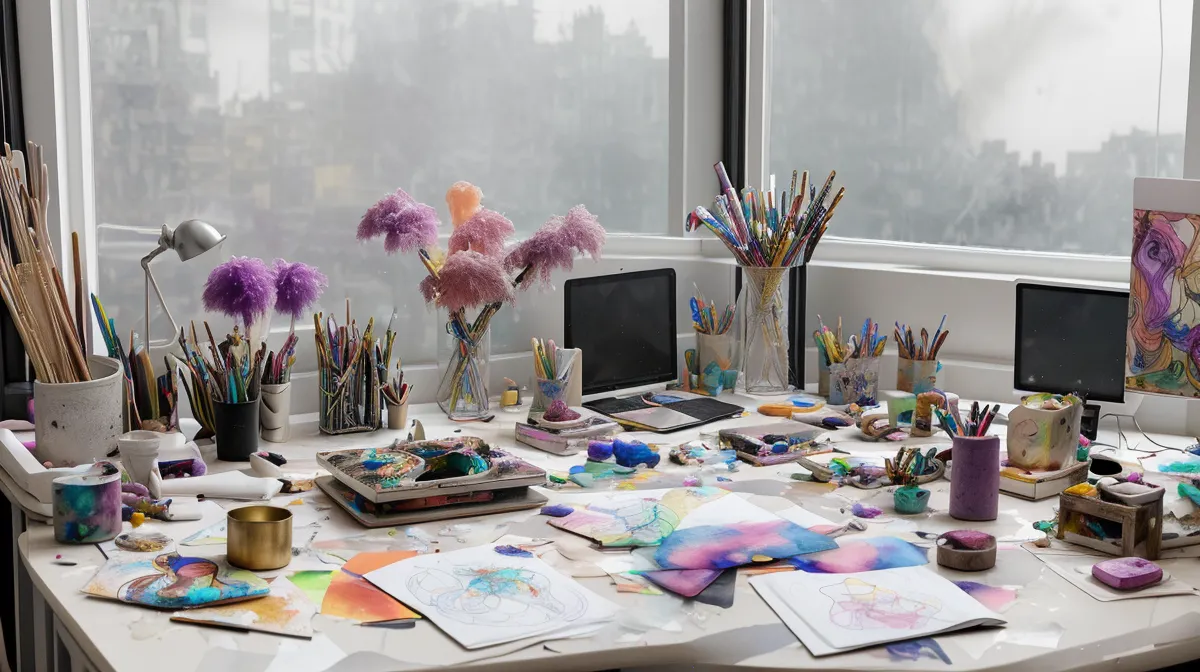
Some mornings I sit down at my drafting table — a secondhand thing with a laminate top scarred from years of x-acto knives that weren't mine — and I'm not trying to copy what I saw overnight. That never works; it's like trying to draw a cloud from memory, you get the shape but not the specific light. Instead I'm chasing the feeling: the way light sat behind the gold streets, the particular vibration of a color I still haven't mixed in real life.
Before bed, I usually clear off the small altar shelf wedged between my bookcases — not for ceremony, just tidying — and there's always a fine grit of dried sage caught under my nails afterward, the kind of small physical anchor that settles me before I even lie down and start the phrase.
A few days after the map dream, the same gold-streets palette showed up half-formed in a client mockup, which either means something or means my brain just really likes that color combination right now. I've stopped needing it to be a synchronicity to still find it useful.
It's not shadow work, exactly — that happens more on the page, with a pen, when I'm awake — but it rhymes with it. This whole thread traces back to the awakening that cracked my life open in the first place, and I still don't have a tidy explanation for that stretch of time. I'm not trying to give you one here either.
None of this is about controlling the images, it's about showing up as a decent witness to whatever the night already built without me. If you deal with real sleep problems or chronic insomnia, talk to someone qualified before rearranging your sleep habits around any of this; I'm not that person, just an illustrator who got curious. The one thing I'd actually pass along is smaller than it sounds: stop trying to script the dream and start paying attention to what's already arriving. That shift did more for my work than any phrase I ever repeated at bedtime, and it's the only part of this I'd tell a friend to actually try.