
My shoulders sit an inch higher than usual whenever the co-working space fills up.
I'm an empath — a word I resisted for years because it sounded like something printed on a tote bag — and after two years of paying attention to what my body does around other people's stress, I don't resist it anymore. Freelance life put me in rooms full of strangers' anxiety before I had any language for spiritual boundaries, let alone a way to protect myself without shutting the work down entirely.
None of this shows up on paper as anything measurable. Our hearing range tops out around 20 kHz, and whatever I'm picking up from a room full of stressed-out designers isn't sound in that sense — it's something closer to pressure, a static that sits against the skin instead of the ears. I used to think I was making it up. I don't anymore.
Setting Spiritual Boundaries in a Shared Creative Space
The co-working space I use most days has exposed brick and too many trailing plants, the kind of room designed to feel inspiring rather than draining. It rarely works that way for me. Two years ago, around the same freelance drought that cracked my life open in the first place, I noticed I was coming home from a four-hour drawing session as wiped out as if I'd spent the day arguing with someone. Nobody had argued with me. I'd just been sitting near people quietly panicking about invoices and deadlines, and somehow their panic had found its way into my body before I'd even said hello. So I went looking for something that would fix it in one clean shot.

A Full Day of Breathwork Didn't Fix Anything
That breathwork intensive was the most expensive thing I tried — the kind of full-day session that promises to clear out whatever's stuck in one long sitting. I cried on the mat, big ugly sobs that embarrassed me even alone in a room of strangers doing the same thing.
Afterward, in the integration circle, I sat next to Maren Stockwell, a fellow seeker who'd signed up for the same session, and we exchanged numbers on the way out. Maren processes things by talking them through out loud, sometimes at length, and for weeks after that day she'd text me paragraphs about what had shifted for her. Nothing shifted for me. I went back to the co-working space two days later and picked up the same anxious hum in the room like nothing had happened. That was the moment I started doubting whether the whole "do one big intense thing and get fixed" model applied to how I actually work.
Here is the thing about the shielding advice everyone hands empaths: the golden bubble, the wall of light, the visualization where you seal yourself off from the world. I tried it for months on my commute, picturing a shimmering egg around my whole body. It never stuck. Holding that image in my mind while also trying to function felt like holding a door shut with my shoulder. Eventually my arm gives out and the door swings open wider than before. Trying to be separate from a room you're actually sitting inside takes a kind of effort that has nowhere to go.
Neuroscience has a word for part of what's happening, even if it doesn't cover all of it — we have mirror neurons that fire both when we act and when we watch someone else act. If my studio-mate is quietly panicking over a font choice two feet away, some part of my brain is running the same panic as if it were mine. People in this space call it clairsentience, feeling what others feel as though it's happening in your own body. Knowing the mechanism didn't make the wall work better. It just explained why walls don't.
Last winter — before any of this breathwork or fortress stuff — I felt a sudden tightness under my ribs, sharp enough that I stood up to stretch, convinced something was wrong. Then the coworker two seats over, who'd been sighing at her monitor all morning, packed up and left. The tightness went with her. It wasn't mine to begin with, which is a strange thing to sit with when you're used to trusting every sensation your body hands you as your own — your solar plexus tightening because of something happening across the room, not inside you.

I'm not a therapist or a healer, just someone trying to get illustrations finished without absorbing every deadline panic in the room. If sensations like that ever come with real physical alarm for you, that's a conversation for a doctor, not an internet stranger with a sketchbook.
What Actually Changed
My friend Ingrid Solberg is the person I call when I've been circling a problem for too long without landing anywhere useful. On one of our standing monthly calls, I was describing the fortress thing — the golden egg, the door analogy, all of it — and she just asked, bluntly, why I was trying to keep everything out of a job that requires me to feel things for a living. It wasn't a mystical question. It was practical, almost annoying in how obvious it made the problem sound. I didn't have an answer for her on the call. I sat with it for a couple of weeks instead.
What I landed on borrows more from audio engineering than from anything spiritual. Gain is how sensitive a microphone is set to be — turn it up too high and it picks up the floorboards creaking and a car horn three blocks away, not just the voice in front of it. My gain had been turned up since the freelance drought two years ago, picking up every ambient signal in a room whether it belonged to me or not. The fix wasn't a wall. It was learning where my dial actually sat and turning it down on purpose, a few degrees at a time.
By week four of adjusting my gain on purpose, the log in my notes app was almost boring: fewer afternoons where I came home flattened, more where I didn't need to think about it at all. On one of those unremarkable days, walking up Mississippi Avenue toward New Seasons for groceries I'd been putting off, I stopped in the middle of the sidewalk because the magnolia tree outside the store was in full bloom — huge pink-white blossoms taking over half the sidewalk — and I could have sworn I'd never actually seen it before, despite walking past it a dozen times that spring. Noticing a tree isn't proof of anything. But it was the first time in a while I was looking at something instead of just managing what I felt near it.
Somewhere in that first disorienting year — before any of this settled into something usable — I tried nearly everything the internet had to offer. Journaling through what people call shadow work. Tracking synchronicities when the same numbers kept turning up on receipts and license plates. Sitting with a meditation practice that took months to stop feeling like homework. Asking a moon reading app questions it had no business answering. Wondering, during one particularly rough stretch, if what I was calling anxiety was actually some kind of kundalini energy shift I didn't have the vocabulary for. Writing letters to what I guess counts as my higher self, half-convinced I was talking to no one. A stretch further in felt less like growth and more like free fall, what I now understand as a dark night of the soul, though I only had the language for it afterward. It forced a bigger question about soul purpose I still don't have a tidy answer to, just work I keep doing one illustration at a time. I've written elsewhere about how the whole thing started, and I still use binaural beats while I'm illustrating on the days my gain feels stuck on high, mostly because the rhythm gives my attention somewhere steady to land instead of the room.
The Ritual Is a Zipper, Not a Wall
The ritual I actually use now doesn't have a poetic name, though I've caught myself calling it "zipping up" when I explain it to people, which sounds sillier out loud than it feels in practice. I picture a line running from my feet to the crown of my head and mentally close it, like a zipper, not a fortress. It's the difference between a sponge and a rain jacket — the rain still hits the jacket, it just doesn't soak all the way through to skin. Some mornings I do this before I even leave the apartment, and some days I forget until I'm already sitting in the co-working space with someone else's stress climbing up my spine, and I do it late instead. Late is still better than never.
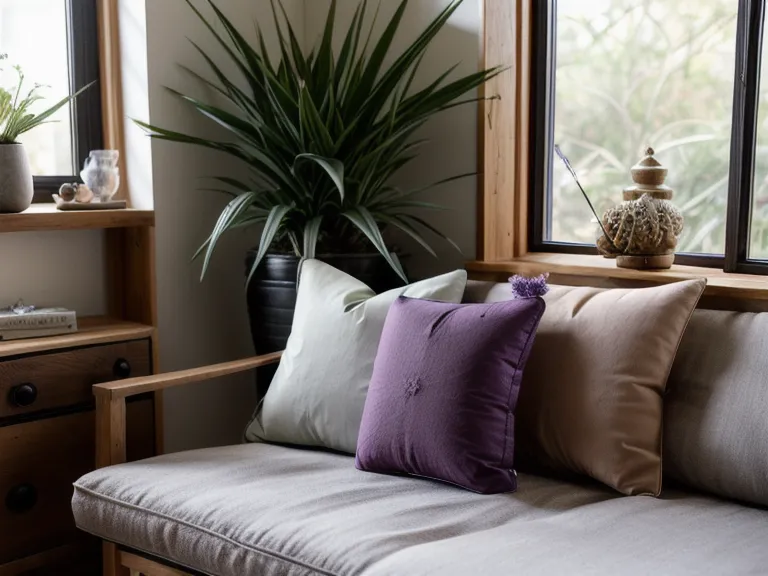
Most of the actual practicing happens at home, in the live/work studio I've had in Sellwood for a while now — a converted print shop with windows that face north and never once let in direct sun, no matter the season. My drafting table has a worn pale patch on the laminate where my hand rests without me thinking about it, and a narrow shelf squeezed into the gap between two overloaded bookcases has turned into an altar without me ever deciding it should be one. The radiator knocks awake before I do most mornings, which used to annoy me and now mostly just tells me roughly what time it is. None of that fixes anything on its own. It's just the room where I remember to check my own gain before I leave it.
Grounding still isn't something I explain well to people who ask about it — something about connecting your own energy to something steady underneath you instead of trying to keep the world out, though I usually just tell people it's less complicated than it sounds and let them figure out their own version. What actually settles me fastest isn't visualization at all. It's sound — letting a singing bowl ring out fully and following the tone all the way down until it disappears into the quiet of the room, instead of cutting it off early the way I used to when I was in a hurry to get back to work. Half a minute of that does more for me than a month of golden-egg visualization ever did.
We only register a sliver of what's actually happening around us — the visible light spectrum humans can see covers a narrow band, and there's a whole lot happening outside it that we still feel even when we can't name it. Sensitivity like this is the same thing that makes the work good in the first place — it's what I lean on to balance being a lightworker with actually making art instead of just absorbing everyone else's version of urgency. But it stops being useful the moment it runs you into the ground.
These days I still sit in that same sun-drenched co-working space, still catch the smell of burnt coffee by early afternoon. When the illustrator two seats over starts spinning with a deadline, I don't automatically spin with them anymore. I check my gain, feel my feet against the floor, and let whatever isn't mine pass through instead of landing. I'm not fixed — there isn't really a fixed, as far as I can tell — but most days now, the leak is smaller than it used to be, and I know where to find the dial.